
The “Automated” Series · Coming soon
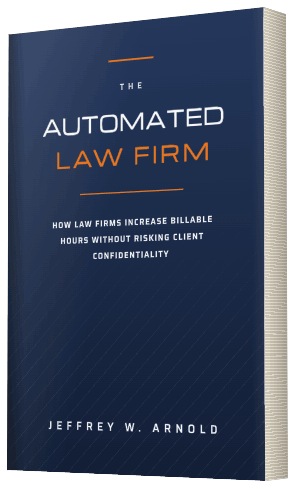
The Automated Law Firm
How law firms increase billable hours without risking client confidentiality.
Part of The “Automated” Series
Every automated process in your firm is on one of two tracks
Track A is pure automation – structured data goes in, structured data comes out, and no AI sits in the middle making judgment calls.
Track B is automation with an AI step inside it. The moment an AI system touches client information and produces an output you rely on, the full weight of ABA Formal Opinion 512 attaches: competence, confidentiality, supervision, fees, and candor. All five.
Most firms are already on Track B without knowing it – a research tool quietly adds an AI feature, a document platform starts summarizing instead of retrieving, and nobody voted on it. This book teaches you to know which track every process in your firm is on, choose Track B on purpose when you choose it at all, and build so the choice always stays in your hands.
The two tracks
The single distinction the whole book runs on – and the test to classify any process in your firm in about a minute.
The five duties
Competence, confidentiality, supervision, fees, and candor – walked through ABA 512 and the opinions it cites.
The compliant build
An implementation checklist, informed-consent mechanics, and the guardrails that protect the firm – and the individual attorney.
Twelve chapters, one practical anchor
Chapter 4 maps your own firm’s ten core processes before the doctrine goes deep – so you see where you stand before you read another page.
Ch. 1-2
The compliance problem nobody told you about, and the two-track test that resolves it.
Ch. 3-4
The safe foundation of pure automation, then the Process Playbook – your ten firm processes, classified.
Ch. 5-8
When AI enters the workflow: the five duties, confidentiality and privilege, and why verification is non-negotiable.
Ch. 9-12
Choosing the right tool tier, the state-by-state data-protection overlay, the compliant build, and where the law is moving next.
The line you can cross without noticing
A passage from Chapter 2 – the distinction the whole book turns on.
The deciding word in the test is “rely.” If a human produces the work and the model only nudges at the margin, you are likely still on Track A. If the model produces the substance and a human waves it through, you are on Track B – and the speed of the wave-through is exactly the risk. The more a tool saves you, the more it is doing, and the more it is doing, the more likely it has crossed.
The firms that get hurt are the ones who never made the choice at all. They didn’t decide to go to Track B. They drifted there, one convenient feature at a time, and inherited the full weight of the rules without ever weighing them. Moving from Track A to Track B is not an act of adoption. It is a condition you can wake up inside of.
Working tools, not just a book
Every chapter points at a decision you have to make. To make those decisions faster, the book comes with a set of one-page thinking tools you can put to work in your own firm immediately – the Track A/B Classifier, the 10-Process Classification Map, and the ABA 512 Compliance Checklist among them. Thinking tools, not compliance guarantees: confirm the current rules in your jurisdiction with your own counsel before relying on any of them. The full tool pages go live with the book.
The Automated Law Firm Academy
The course built on this book – structured modules, working templates, and a certificate, in development alongside the book.

Written by Jeff Arnold, founder of 4Spot Consulting and author of The Automated Recruiter. Not a lawyer, and not offering legal advice – an automation specialist who has spent years helping firms, legal practices included, stop drowning in digital busywork.
One of The “Automated” Series books
Same builder, same standard, one industry at a time. See where this book fits alongside The Automated Recruiter.